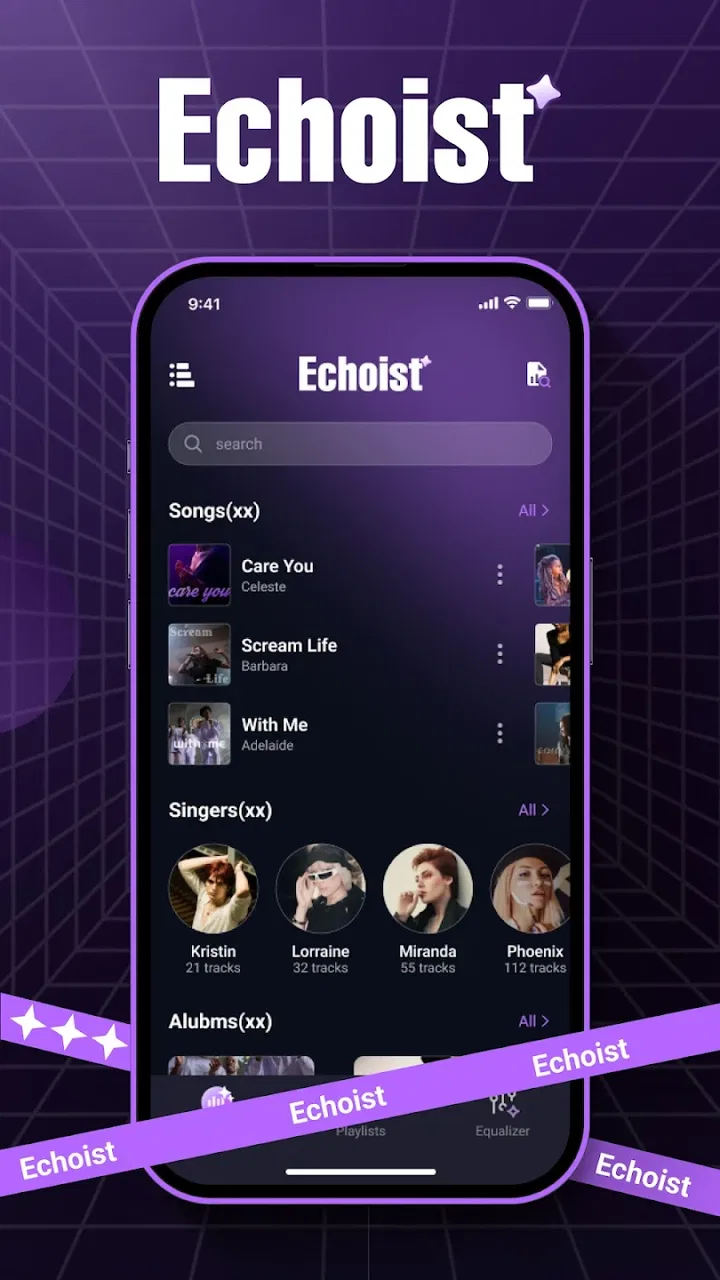
Echoist — Offline Music
- 4.3
- Rating
- 1.00M
- Installs
- Free
- Price

 Analysis by App-foxy
I approached Echoist — Offline Music as a practical listening tool rather than another app to browse endlessly. Its promise is simple: keep music close at hand and make the listening journey feel less dependent on a constant connection. That focus gives it a clear place in the Music & Audio category, especially for people who want a quieter routine around their saved tracks.
After spending time with it, my impression is that its value comes from the habit it encourages. Instead of treating music as a stream of recommendations, I found myself choosing what I wanted before leaving home, checking the playback setup, and then listening without repeatedly reaching for the phone. That sounds modest, but it is exactly the kind of small change that makes an audio app useful in daily life.
How Echoist fits into an everyday listening routine
The first thing I would do with Echoist is create a baseline routine: prepare music while connected, confirm that the intended tracks are available for offline listening, and then use the app during the parts of the day when mobile data or a reliable signal is inconvenient. This works well for a commute, a walk through an area with patchy reception, or a flight where I want music without building my whole trip around connectivity.
You May Also Like

 Blood Strike: 2.5 Anniversary
Blood Strike’s Loadouts Turn Every Drop Into a Tactical Gamble
A close look at Blood Strike’s custom loadouts: how fast access to signature weapons reshapes its battle royale rhythm, rewards preparation, and narrows the gap between fights.

 Pandora - Music & Podcasts
Pandora’s Music Is Easy to Start, but Harder to Recover
Pandora’s strength is its low-effort path from a seed to a station. Its weak spot is how much confidence it asks you to place in connection, setup, and quiet recovery.

 8 Ball Pool
 Is Built on Rivalries, Rematches, and Routine
A close look at the rivalries, rematches, shared routines, and unanswered safety questions that turn a quick pool match into a persistent mobile community.

 Samsung Music
’s Quiet Strength Is Playing What You Already Own
Its reach comes less from spectacle than from dependable access to a personal library. That simplicity is both the app’s strongest retention engine and its ceiling.

 AccuWeather: Weather Radar
AccuWeather Review: A Quick, Clear Forecast for Everyday Decisions
For everyday plans, the best forecast is the one you can understand quickly. AccuWeather makes rain timing, radar, and local conditions easy to act on, with a few trade-offs.

 Hill Climb Racing
Why Hill Climb Racing Still Turns Crashes Into One More Run
A tiny car, a bumpy hill and one more upgrade: Hill Climb Racing keeps resurfacing because its simple chaos makes every near-miss feel personal.
More From Our News Desk
View All News


That workflow also changes how I choose music. With a typical streaming service, I might open the app without a plan and lose time moving between recommendations, playlists, and search results. Echoist feels better suited to a deliberate selection. I decide on an album, a small group of tracks, or a mood before I disconnect, then let the listening session run its course.
A realistic example is a morning walk. I can prepare a calm sequence the night before, check that my phone is ready, and start playback before leaving. If the walk becomes longer than expected, I am not forced to stop and search for another song. The benefit is not dramatic technology; it is fewer interruptions and less dependence on the quality of the network around me.
The app is free, which lowers the barrier to trying this style of listening. It is also aimed at an Everyone audience, so the presentation is approachable for a broad range of users. I would still encourage new users to spend a few minutes learning the basic playback flow instead of assuming that every offline habit will be obvious immediately.
WAKStudios has kept the concept focused enough that I do not feel I need to treat Echoist as a complete replacement for every audio service. I see it more as a dedicated listening space. That distinction matters: people who enjoy discovery, podcasts, radio stations, social sharing, and large recommendation systems may prefer a broader alternative, while people who already know what they want to hear can benefit from a less distracting setup.
The preparation step matters more than the listening step
Offline listening is only convenient when preparation is predictable. My advice is to make the setup part of an existing habit, such as charging the phone at night or getting ready before a trip. Select the music then, rather than waiting until you are already outside. This avoids the frustrating situation where the app is ready but the music you wanted is not.
I would also keep separate listening intentions. A short group of tracks for commuting is easier to manage than one enormous collection containing everything. A second selection for exercise, reading, or winding down can make the app feel faster because the decision has already been made. This is one of the more useful ways to get value from an offline-focused player: reduce the number of choices before playback begins.
There is a trade-off here. A carefully prepared library gives me control, but it asks me to think ahead. If I want a service to surprise me with fresh music every few minutes, Echoist is not the natural choice. Its strength is consistency, not endless novelty.
Settings worth checking before relying on it
I recommend opening the settings area early, even if the default behavior seems fine. In an offline music app, small playback choices can affect the whole experience. Check how the app handles the end of a selection, whether playback continues in the way you expect, and whether the interface gives you a clear indication of what is ready to play without a connection.
It is also worth checking the app’s behavior with headphones and the phone’s screen locked. I prefer to test this at home before depending on it during travel. A player can seem perfectly comfortable while the display is active, then feel less convenient once I put the phone away. Testing the complete routine reveals friction that a quick launch does not.
Another good habit is to review storage before preparing a large listening set. I would not fill the phone casually with music that I may never hear. Keeping the offline collection intentional makes it easier to find the right material and leaves room for other files. This is especially important on older devices, where available space can already be limited.
The current version is 1.0.6, and I would treat that as a reason to stay attentive to how the app develops rather than assuming it already covers every advanced preference. The core experience should be judged on the workflow it offers today: selecting music, making it available, and listening with fewer connection worries.
One setting-related tip I found useful is to decide whether I want a session to feel continuous or contained. For focused work, I prefer a defined sequence that ends naturally. For a longer journey, I want the app to keep the listening flow simple and avoid unnecessary interaction. Thinking about the purpose first helps me choose a better collection and prevents me from blaming the player for a poorly planned session.
Shortcuts and repeatable patterns that save time
Experienced use is less about discovering a secret button and more about repeating a reliable sequence. My preferred pattern is: prepare the music, verify availability, start playback, lock the phone, and leave the app alone. That order prevents me from beginning a walk with uncertainty about whether the first track will actually be ready.
I also recommend keeping one dependable “default” selection. It could be the music I use most often for commuting or a group of familiar tracks for situations where I do not want to make decisions. A default collection acts like a shortcut even if I never touch a widget or special control. It turns the app from something I browse into something I can start quickly.
For longer trips, I would prepare more than one mood rather than one oversized sequence. A quiet set for the beginning, something livelier for the middle, and a familiar choice for the return journey are easier to navigate than a random mixture. This approach is particularly helpful when I am using the phone with minimal screen time.
Another practical pattern is to refresh the offline selection in small batches. Instead of rebuilding everything at once, I would replace only what I have finished hearing. That keeps the library current without turning preparation into a chore. It also makes it easier to notice which music genuinely earns a place in the offline collection.
These habits reveal an important strength: Echoist rewards users who know their listening context. If I am willing to prepare, the app can make music feel calm and dependable. If I expect the app to solve every choice instantly, the experience may feel more limited than a large streaming platform.
Where the offline approach reaches its limits
The central limitation is also the defining trade-off. Offline listening gives me independence from the network, but it depends on preparation and available local space. I cannot expect the same spontaneous discovery experience I get from a service built around live catalogs, algorithmic suggestions, or constantly changing stations.
That makes Echoist a weaker fit for someone who listens mainly through search. If my routine is to remember an artist at the last moment and play something immediately, I would probably be happier with a more expansive streaming alternative. The same applies if podcasts, live audio, or a large social layer are essential parts of my listening day.
I would also be cautious about treating it as a universal music solution for a shared household. Different listeners may want completely different prepared collections, and a focused offline workflow is most comfortable when one person controls the selection. For an individual phone and a personal routine, that is not a serious problem; for several people sharing one device, it can become inconvenient.
Another limitation is psychological rather than technical: preparation can feel like work when my schedule changes constantly. If I leave home unexpectedly, I may not have the right selection ready. In that situation, a connected service is more flexible. Echoist is at its best when I can anticipate the next listening session, not when I need an unlimited catalog at a moment’s notice.
The app’s scale suggests that many people are already interested in this kind of experience. It has passed one million installs and holds a 4.3 average from around 1.3 thousand ratings. Those figures tell me that the idea has reached a meaningful audience, but they do not remove the need to test the workflow against my own habits. Offline music is personal: what feels wonderfully simple to one listener may feel restrictive to another.
I would also avoid judging it only by the first few minutes. The real question is whether the preparation-to-playback cycle becomes easier after several uses. If I can build a routine that takes little thought, the app earns its place. If I repeatedly forget to prepare music or keep searching for features associated with larger services, I should choose a different tool rather than forcing Echoist into a role it was not designed to fill.
Who should use it, and who should skip it
I would recommend Echoist to listeners who already have clear music preferences and want fewer interruptions. It makes particular sense for commuters, walkers, travelers, people with unreliable reception, and anyone trying to reduce casual screen time while listening. It is also a reasonable option for someone who wants a free way to organize a more intentional audio routine.
It is less suitable for listeners who measure a music app by the size of its discovery engine. If daily recommendations, instant access to unfamiliar releases, radio-style playback, or a broad range of audio formats matter more than offline independence, a conventional streaming platform will probably feel more satisfying.
Before settling on it, I would answer three practical questions. Do I usually know what I want to hear? Am I willing to prepare music before leaving a reliable connection? Do I prefer a focused player over a large entertainment hub? If the answer is yes to all three, Echoist has a clear advantage. If the answer is no, its main benefit may not outweigh the extra planning.
Device compatibility is also straightforward in principle: the app supports Android 7.0 and later, so users on older supported phones can consider it without needing a modern handset. I would still judge the experience on the particular phone I use, especially if storage is tight or the device handles background playback conservatively.
My verdict after building a real routine
Echoist — Offline Music works best when I treat it as a prepared listening companion, not as a replacement for every kind of music service. Its strongest quality is the way it supports a repeatable sequence: choose music in advance, make sure it is ready, and listen with fewer distractions. That is a meaningful benefit for everyday travel and quiet personal routines.
I like that the app does not need to win every category to be useful. It has a specific purpose, and the free price makes experimenting with that purpose easy. The main cost is not money but planning. Users who accept that exchange can get a calmer experience; users who want constant discovery may find the same focus too narrow.
My final recommendation is to give it a fair trial during a complete offline scenario rather than judging it from a quick launch. Prepare a modest selection, use it on a commute or walk, test the playback behavior with the screen locked, and notice whether the routine feels easier by the end. If that experience matches the way you listen, Echoist is a sensible addition to a Music & Audio collection. If you need an always-changing catalog with minimal preparation, another app will be the better fit.
FAQs for Echoist — Offline Music
01What is Echoist — Offline Music and how does it work?
Echoist — Offline Music is a mobile application that allows users to download and listen to their favorite music tracks without an internet connection. The app features a user-friendly interface where you can create playlists, organize your library, and enjoy seamless playback. It supports various audio formats and provides high-quality sound for an optimal listening experience.
02Is Echoist — Offline Music free to use?
Echoist offers both free and premium versions. The free version provides basic features, while the premium version unlocks advanced functionalities such as ad-free listening, unlimited downloads, and enhanced audio quality. Users can choose a subscription plan that best fits their needs, with options for monthly or annual payments.
03How do I download music for offline listening in Echoist?
To download music, simply search for your desired tracks within the app, then tap on the download icon next to each song. The music will be saved to your device for offline playback. You can access these tracks anytime, even in areas with no internet coverage, ensuring uninterrupted music enjoyment.
04What audio formats are supported by Echoist — Offline Music?
Echoist supports a wide range of audio formats, including MP3, AAC, FLAC, and WAV. This versatility ensures that users can import and play almost any music file they have. The app's compatibility with various formats makes it convenient for users with diverse music libraries.
05Can I create and manage playlists in Echoist?
Yes, Echoist allows users to create and manage playlists with ease. You can add tracks to existing playlists or create new ones to organize your music library according to your preferences. The app also provides features for editing playlist names and rearranging song orders, enhancing your music management experience.
Pros
- Offline playback for data saving
- User-friendly interface
- High-quality audio support
- Customizable playlists
- No ads in premium version
Cons
- Limited features in free version
- No streaming radio option
- Occasional app lag
- Requires storage space
- No social media integration

Echoist — Offline Music
Gallery